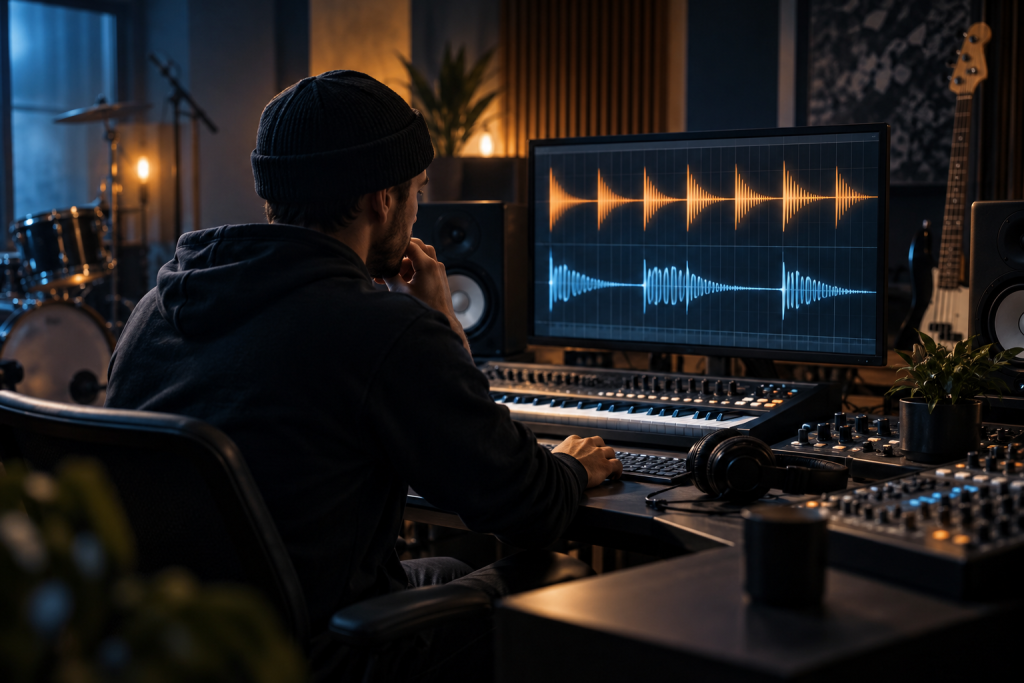
Every techno producer hits the same wall around the third hour of a session: the kick slams, the bassline is solid on its own, and together they turn into a muddy thump with no punch. The reflex is to reach for a sidechain compressor and duck the bass to death. That works. It also flattens your groove into a mechanical pump if you’re not careful.
Sidechaining kick and bass is not one technique. It’s a spectrum, and where you land on it decides whether your low end breathes or just twitches in time.
What sidechaining actually does (and where it stops being subtle)
Sidechain compression uses one signal to control a compressor on another track. The kick triggers the compressor on the bass. When the kick hits, the bass drops. When the kick stops, the bass comes back (source: SoundsHeavy mixing guide).
That’s the mechanical definition. What matters is the range. A subtle sidechain, around 2 to 4 dB of gain reduction, gives you separation without an audible effect. You feel it but you don’t hear it. Aggressive sidechain, 6 to 10 dB or more, produces the obvious pumping that defines a lot of dance music. In that case the artifact becomes the groove (source: SoundsHeavy).
There’s a useful distinction hiding here. Ducking attenuates by a fixed amount. Sidechain compression creates variable attenuation that tracks the trigger’s level (source: Wikipedia, Ducking). For kick and bass, that difference matters. A fixed ducker will always pull the bass down by the same amount whether the kick is a full-throttle 909 hit or a ghosted offbeat. Sidechain compression responds to level, so a light kick ducks the bass less.
Which one you want depends entirely on your kick pattern. A four-on-the-floor techno kick barely varies. A broken beat with ghost notes does. If your kick dynamics move around a lot, variable attenuation is usually the smarter pick.
Attack and release: where most mixes go wrong
Attack time controls how fast the bass ducks after the kick triggers. Too slow and the bass masks the kick’s transient, which is the exact thing you’re trying to fix. If the attack is too fast, you get audible clicks as the bass level jumps. The fix is a slightly longer attack, around 5 to 10 ms, which smooths the transition while still clearing space quickly (source: SoundsHeavy).
I usually start around 3 ms on the attack and only lengthen it if I hear clicks. On synthy sub-bass, 5 ms is often the sweet spot. On a snappy 808-style bass, I’ll go faster and accept a little bite.
Release is the one people neglect. The rule is simple: the release should finish before the next kick hits. If it doesn’t, the bass never recovers and you end up with a permanently ducked, lifeless low end. That subtle accumulated ducking is what kills grooves.
For moderate tempos, 100 to 200 ms release times work well. Faster tempos need shorter releases, around 50 to 100 ms (source: SoundsHeavy). At 130 BPM a kick lands every 461 ms. That leaves you plenty of room, but if your pattern has offbeat kicks you’re working with half that. Do the math for your actual pattern, not a generic tempo chart.
Auto-release exists and modern compressors handle it decently. I still set it manually for kick and bass. The whole point is that the release locks to your kick pattern, and auto modes don’t know where your ghost notes are.
Threshold and ratio
Threshold decides what trigger level causes ducking. Lower thresholds mean ghost notes and quieter kicks pull the bass down. Higher thresholds mean only the loudest hits register (source: SoundsHeavy).
Set it too low and your bass gets ducked by hits it shouldn’t react to. Set it too high and the quiet kicks get masked. Watch the gain reduction meter while your loop plays. If it moves on hits you didn’t intend, the threshold is too low.
Ratio is where the pumping personality lives. Light ratios give you transparent separation. High ratios give you the aggressive dip. I rarely go above 4:1 unless I want the duck to be an audible part of the rhythm.
The cleaner alternative: frequency-conscious ducking
Broadband sidechain pulls the entire bass down, including the upper-bass harmonics that don’t actually conflict with the kick. That’s a waste. Your kick occupies the sub region, but your bass’s character often lives above 200 Hz.
Multiband sidechain compression only ducks the frequencies that clash. The low band ducks hard, the higher bands stay put. You keep bass clarity and attack while still creating sub separation (source: SoundsHeavy).
Then there’s frequency-conscious ducking, which analyzes which frequencies the kick occupies and reduces only those ranges on the bass. Plugins like Trackspacer do this automatically (source: SoundsHeavy).
This is my preferred approach for progressive and melodic material where the bass carries melodic weight. The low end separates without the bassline feeling chopped. For straight-up peak-time techno, plain sidechain compression still wins because the pumping is the point.
When sidechain isn’t the answer
Here’s the honest part: sidechaining is often a bandage over a composition problem.
If your kick and bass sit in the same frequency band and fight, one of the cleanest fixes is to not have them occupy the same space in the first place. Place one kick and one bass in the low-frequency range, and have them mostly present in different bands. Only reach for sidechain when they genuinely share frequencies (source: MajorMixing).
That means arrangement and sound selection before dynamics. Pick a kick with weight centered around 50 to 60 Hz and build a bass whose fundamental lives higher, or vice versa. Suddenly you need far less ducking, or none.
The other trap is layering bass. Layering kicks is fine and often sounds great. Layering bass is a mistake. You end up with notes at inconsistent volumes and a chaotic low end that no compressor can rescue (source: MajorMixing). One clean bass beats three stacked ones.
And keep everything else out of the sub. If your pad, your room reverb, or a stray synth is lurking down at 40 Hz, no amount of sidechain on the bass will fix the mud (source: MajorMixing).
Trigger sources: don’t just feed it the kick
The kick itself isn’t always a great trigger. A kick with heavy sub content can confuse the compressor’s detection. High-pass filtering the trigger around 100 Hz often triggers more cleanly.
A dedicated trigger track is even more reliable. A simple click or pulse, aligned to your kicks, gives consistent triggering no matter how much your kick’s dynamics vary (source: SoundsHeavy).
If your DAW supports it, MIDI-triggered sidechain is the cleanest option of all. The compressor responds to MIDI notes instead of audio detection, so you get perfect timing and zero false triggers (source: SoundsHeavy). No threshold guessing, no ghost-note problems.
The version almost nobody mentions
Ducking isn’t only for kick and bass. Pull the reverb and delay sends down when the dry bass hits, and the tails stop smearing your low end. You’d hear this on records like Céline Dion’s “The Power Of Love,” where the reverb becomes audible only when she pauses (source: Wikipedia).
In a techno context, keying a ducker off your kick to duck the bass reverb return is a quiet trick that makes the whole low end tighter without touching the bass itself.
A starting point you can actually use
- Attack: 3 to 5 ms. Longer if you hear clicks.
- Release: 100 to 200 ms at moderate tempo, 50 to 100 ms when things get fast. Always shorter than your kick interval.
- Ratio: 2:1 to 4:1 for subtle separation, higher if you want audible pumping.
- Reduction: 2 to 4 dB for transparent, 6 to 10 dB for stylistic.
- Trigger: high-passed kick or a dedicated click track. MIDI if available.
- Always: check that the bass fully recovers before the next kick.
Treat those as a launchpad, not gospel. The threshold between effective ducking and audible artifacts varies by material, and only critical listening in your own track tells you where that line is (source: SoundsHeavy).
The real skill isn’t knowing how to sidechain. It’s knowing how much to duck, and being willing to not duck at all when your kick and bass already have their own space. Sometimes the best-sounding low end is the one you didn’t have to compress.