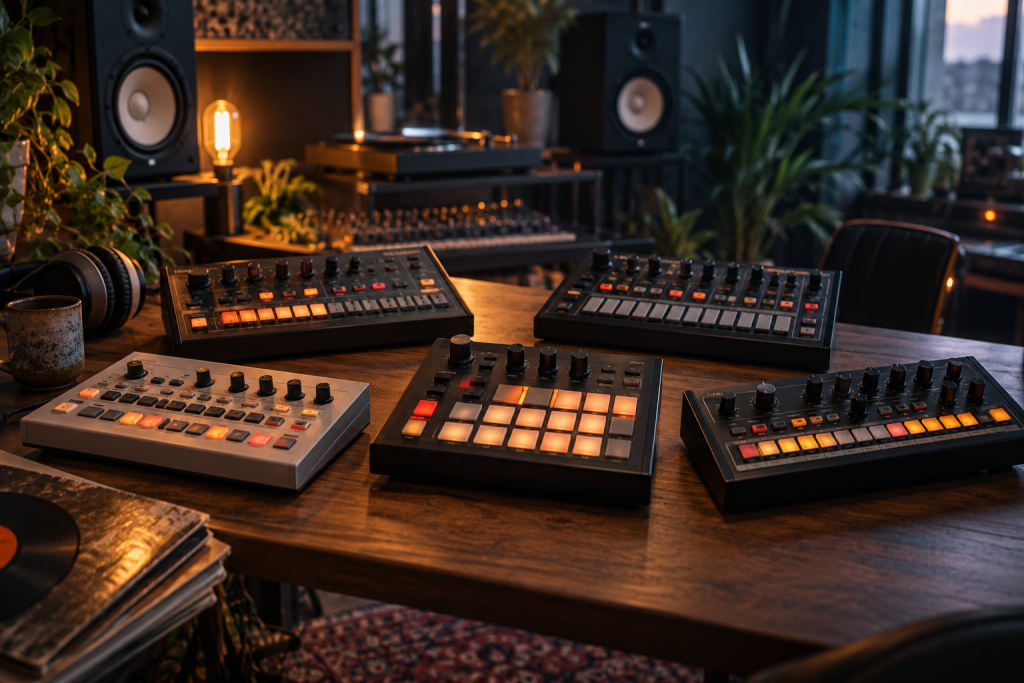
Six hundred dollars doesn’t buy you a vintage 808. It buys you a machine that gets you 80 percent of the way there, plus a warranty. I’ve cycled through more budget drum boxes than is healthy, partly out of curiosity and partly because I keep thinking one of them will replace my DAW workflow. Most don’t. But a handful genuinely earn their rack space, and the gap between cheap and cheap-sounding has never been narrower.
Here’s what’s actually worth your money right now if you want hardware that bangs without a plugin doing the heavy lifting.
Behringer BMX: The DMX Clone That Has Its Own Character
The BMX is Behringer‘s take on the Oberheim DMX, and it’s the most interesting budget drum machine on this list because it doesn’t pretend to be a LinnDrum. Behringer already made the LM Drum for that. The BMX leans into the gritty DMX/DX sound, and the samples are the reason to care.
Per Audiofanzine’s review, the BMX ships with 121 factory percussion instruments pulled from the characteristic ’80s sample set: punchy, crackly, with real digital grit. You also get African and Latin percussion, an electronic kit that sits somewhere between a Fairlight and an SDS, and two pop kits that some listeners reckon are Yamaha RX5 samples. Notably, the BMX has no LinnDrum sounds, which is a deliberate choice. If you want that particular saturated snare, this isn’t it. If you want toms and cymbals that come out louder and brighter than the LM Drum’s, it is.
The I/O is where the BMX punches above its weight:
- Three trigger outputs assignable to any pad via the Synthtribe app (mini-jack)
- Sync in and out (mini-jack)
- Full MIDI DIN trio plus USB-B for notes, CC, sync, sample transfer, and firmware
- Individual outputs that bypass the mixer and effects, and inserting a cable doesn’t cut the voice from the stereo mix
- 12V/2A external power with a push-button switch
That individual-output behavior matters. On a lot of budget boxes, patching out a voice removes it from the main mix, which kills live performance flexibility. Here it doesn’t. The real annoyance Audiofanzine flags is loose, wobbly sockets, and that’s the trade-off at this price. Expect to be gentle with your cables.
Arturia DrumBrute Impact: The Workflow Machine
Analog drums, a sequencer that feels like an instrument, and a price that hovers around the $300 mark depending on where you buy. The Impact is the drum machine I recommend to people who want to actually play the thing rather than menu-dive. The kick is punchy, the snare is serviceable, and the FM drum voice gives you metallic textures that a lot of analog boxes miss. The distortion circuit is the secret weapon: run the whole kit through it and you get a cohesive, aggressive glue that makes the machine sound more expensive than it is.
The downside is the hats. They’re thin, and they sit awkwardly against the kick in a dense mix. You’ll want to process them, or layer them with a sample. If you’re doing techno or electro where the hats carry the groove, budget for a plugin to thicken them.
Elektron Model:Cycles: Six FM Tracks, Zero Samples
This is the odd one out because it’s fully synthesis-based. Six FM engines, each tuned toward a percussion role: kick, snare, metal, perc, tone, chord. The sequencer is the Elektron workflow at its most stripped-back, which is both the appeal and the friction point.
What the Cycles does brilliantly is FM percussion that sounds nothing like the sample-based boxes on this list. Snappy metallic hats, weird tom textures, bass drums with a clean click. It also does melodic work if you push it, though the lack of a proper filter envelope per track limits how far you can take that. Where it frustrates: the pads are stiff, there’s no song mode on the early firmware (Elektron added one later), and the menu structure assumes you already know Elektron’s language. First week with this thing is a slog. Second week, it clicks.
Roland TR-6S: The Modern Classic Compromise
If you want the TR-808 and TR-909 sounds without paying vintage prices, the TR-6S is the obvious pick. It’s an ACB-modeled recreation with the full 808, 909, 707, 727, and 606 kits, plus FM drums. Six tracks, a decent sequencer, battery power, and it fits in a backpack.
The catch is the interface. Four knobs and a small screen means a lot of shift-pressing and menu-scrolling. Coming from an actual 808, where every parameter has a dedicated slider, the TR-6S feels like programming through a keyhole. The sound is right. The workflow is not for everyone. For $400-ish, though, it’s the cheapest way to get legitimate 909 kicks in hardware form.
Korg Volca Drum: Digital, Weird, Cheap
Two hundred dollars gets you a digital percussion synth with a physical-modeling engine that sounds like nothing else in this bracket. The Volca Drum isn’t trying to recreate an 808. It’s a string-and-membrane modeling engine with a waveguide section, and it produces clangs, boings, and metallic hits that sit beautifully in minimal techno.
It’s also fiddly. The knobs are small, the sequencer is 16 steps with limited pattern memory, and syncing it to a larger setup requires either the sync cable or MIDI (which the original Volca Drum does support via a 3.5mm adapter). I don’t use it as my main drum source. I use it as a texture generator, layered under cleaner kicks for that metallic tail. At this price, that’s a fair job description.
What Actually Matters at This Price
Ignore the spec sheet on the box. The three things that determine whether a sub-$600 drum machine earns its place in your studio:
- Individual outs. If every voice is glued to a stereo pair, you’re mixing in the box anyway, and the hardware is just a sound source. Individual outs let you track drums properly and process kick and snare separately.
- Sync reliability. MIDI DIN is still the standard for a reason. USB-MIDI on budget gear drifts, especially over long sessions. If a box only has USB, factor in a MIDI host.
- Whether you enjoy playing it. This is the one nobody talks about. A drum machine you don’t want to touch is a $400 paperweight. The DrumBrute Impact gets used because the sequencer is fun. The TR-6S gets used because the sounds are right. The Volca Drum gets used because it surprises me. That’s the real filter.
None of these will out-mix a proper sample library in Ableton. But they’ll give you something a DAW can’t: a physical surface with limits that force decisions, and a sound you can’t quite recreate by dragging a WAV into a drum rack. If you’ve been producing entirely in the box and feeling stale, one of these is a cheaper reset button than a new interface or a monitor upgrade.