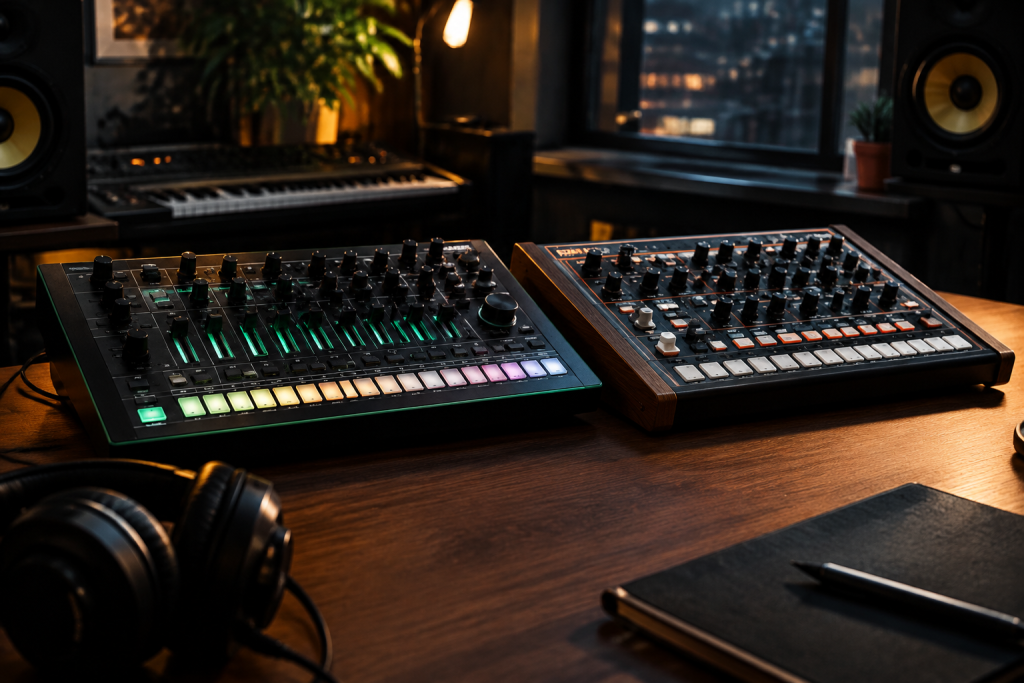
Two drum machines, two very different ideas about what “live” means. The Roland TR-8S and the Arturia DrumBrute Impact both want to be the box you actually play with your hands, not the one you program with a mouse. But they get there in opposite ways.
I’ve spent enough time with both to have opinions. The short version: the TR-8S is the more capable machine, and the DrumBrute Impact is the more fun one. Which matters more depends entirely on how you improvise.
The core difference: commitment vs. possibility
The DrumBrute Impact is an analog drum machine with a deliberately small feature set. You get a fixed voice architecture, a knobby interface, and almost no menu diving. That constraint is the whole point. When you turn a knob on the Impact, something happens immediately and audibly. You don’t think in parameters. You think in movements.
There’s a real psychological effect here worth naming. With hardware that demands tactile interaction, you build muscle memory fast. Your hands learn where the kick decay lives and how far the distortion goes before it breaks up. That relationship turns the machine into a playing partner instead of a sound library. You twist something out of curiosity and land on a texture you would never have dialed in on purpose.
The TR-8S works the same way in principle. Lots of knobs, lots of faders, and a step sequencer you can jam on. But Roland packed it with far more: sample import, ACB-modeled 808/909 kits, per-track effects, a much deeper sequencer. That depth costs you menu navigation. And every menu is a place where improvisation slows down.
Where the TR-8S wins
If your live set needs variety, the TR-8S is hard to argue with. Sample import alone changes what’s possible. You can load your own one-shots, layer them with the modeled kits, and build a palette that sounds like your tracks instead of like a factory preset. Try doing that on the Impact.
The effects are the other big one. Per-track and master effects on the TR-8S mean you can perform transitions, filter sweeps, and build-ups without external gear. For a bitwig/”>live improvisation rig, that’s a lot of utility in one box.
The catch
Depth invites fiddling. The TR-8S gives you so many options that it’s easy to spend your set scrolling instead of playing. The machine rewards preparation. If you show up with kits already built and patterns already loaded, it’s a monster. If you show up cold, you’ll fight it.
Where the DrumBrute Impact wins
It wins on immediacy. Everything you need is on the front panel. The sequencer is fast to use, the swing and randomness controls are made for live performance, and the analog voices have a character that’s genuinely its own. It sounds like a drum machine, not a sample library.
That constraint forces decisions. You can’t endlessly tweak, so you commit, and the track moves forward. There’s something to be said for a box that won’t let you second-guess yourself past the point of no return. The Impact is that box.
The trade-off is real though. No sample import. Fewer voices. Less sound design range. If you want a 909 hi-hat and a layered clap, the Impact can’t give it to you.
So which one for live improvisation?
Ask yourself one question: what does “improvise” mean for you?
- If it means building tracks on the fly from your own sounds, with effects and samples and layered kits, get the TR-8S. It has the range to carry a whole set.
- If it means playing the machine like an instrument, with your hands on the knobs and your ears leading, get the DrumBrute Impact. The constraint is the feature.
I’d also say this: the TR-8S is the safer buy if you only get one. It does more, and it can sound like almost anything. The Impact is the better buy if you already have a sampler or a DAW handling the rest of your sound. It’s a specialist, and it’s very good at its specialty.
One more thing worth considering. Commitment shapes how you write. When you record a take from a machine that freezes your sound on the way out, you stop micro-adjusting and start making decisions. Both of these boxes push you toward that. They just push you at different speeds.
For pure live improvisation, I reach for the Impact more often. It’s the one I stop thinking about. And that, more than any spec sheet, is what makes a machine playable.