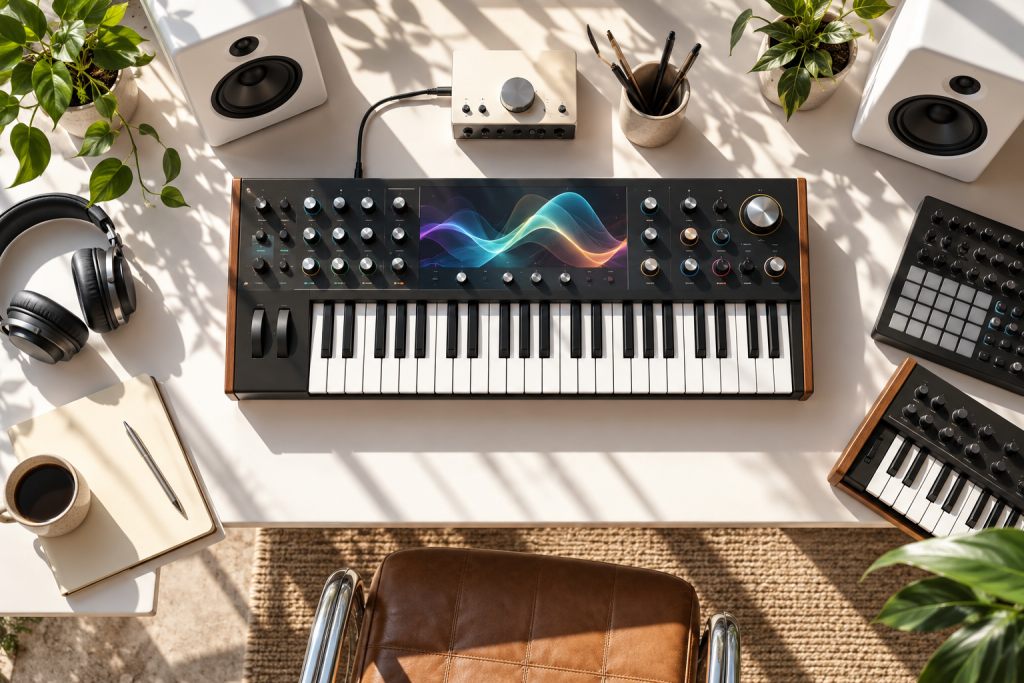
Most people installing Pigments expect to be overwhelmed by the modulation matrix and end up using it as a very expensive preset browser. That is the wrong way round. The whole point of this instrument is that the routing is the easy part, and the sound design falls out of it almost by accident. So the real question about version 6 isn’t whether it has enough new oscillators. It’s whether the new engine gives you something you couldn’t get before, or just another tab to scroll past.
I’ve been running Pigments as my main soft synth for a while now, and my honest read on 6 is mixed but leaning positive. Here’s the breakdown, including where it gets on my nerves.
What Pigments actually is, for the uninitiated
Arturia has a reputation built largely on faithful recreations of vintage hardware, from the Memorymoog through to the classic drum machines. Pigments is the odd one out. It doesn’t emulate anything. According to MusicRadar, it’s one of the few Arturia titles that doesn’t model an old keyboard or synth, and it’s arguably the company’s most capable instrument.
The architecture is built around multiple synthesis types running side by side. Historically that meant Analog, Wavetable, Sample and Harmonic engines, and you can layer them within a single patch. The genuinely useful part has always been the modulation system, which lets you wire almost anything to almost anything and get evolving, moving sounds without a degree in signal flow. That’s the reason people keep it installed, not the oscillator count.
If you’ve used the previous version, you already know the layout. What changed in 6 is the engine options and how they interact. Let me get into the part that actually matters.
The new engine: what it does differently
I’m going to be careful here, because a lot of what gets written about new synthesis engines is hype dressed up as analysis. The interesting thing about the direction Arturia is pushing, and the same idea shows up in hardware like the Waldorf Iridium’s Seeds engine, is a move away from a fixed oscillator model toward something that changes character stage by stage.
On the Iridium, the Seeds engine produces wavetable-style sounds but lets the synthesis approach shift from one step to the next, so as the table unfolds you get a run of distinct sonic colours rather than one continuous sweep. That’s a genuinely different approach to wavetable movement, and it’s the kind of thing that’s well suited to ambient work and sound design.
Pigments 6 leans into similar territory. The point isn’t that it makes prettier pads. The point is that a single held note can move through several different timbral identities without you automating anything. You get the sense of a sound evolving rather than a filter opening.
Where it earns its keep
Textural work. Long, evolving drones. Sound design for anything that needs to feel alive across eight bars without obvious movement. That’s where the new engine is worth the upgrade on its own if that’s your lane.
What it won’t do is fix a thin patch. If your problem is that your bass doesn’t sit in the mix, a fancier wavetable won’t help. That’s arrangement and EQ work, not synthesis.
The modulation system is still the headline
I’ll say the unpopular thing: the new engine is not what makes me keep opening Pigments. The modulation is.
You can drop a modulator on a parameter, set it running, and within a minute you have something that sounds like it took an afternoon. The visual feedback is immediate. You see the modulation moving, you see the shape of what you’re building. That matters more than people admit. When you can see a source feeding a destination, you experiment more. When you’re clicking through tabs guessing, you don’t.
Compare it to something like Phase Plant, which is a fantastic sound design tool built around a modular drag-and-drop approach. Phase Plant gives you more freedom to build the instrument from scratch. Pigments gives you a curated set of engines and makes the routing frictionless. Different philosophies. For someone who wants to finish tracks rather than build synth architectures, Pigments usually wins on time.
What’s annoying
The preset browser still gets in the way. Factory patches skew heavily toward the big, cinematic, modulated side of things, which is fine for scoring and terrible if you just want a clean saw to start from. I end up initialising a patch almost every time.
CPU is also worth flagging. Run a couple of instances with four engines all moving and the new spectral-style processing, and you’ll feel it on a busy session. It’s not catastrophic, but it’s not the lightest synth on the market either, and if you’re on an older machine you’ll be bouncing to audio sooner than you’d like.
The upgrade pricing is the other sore point. Arturia’s model means existing owners get a discount, but whether it’s worth it depends entirely on how much you’ll use the new engine. If you’re a preset surfer, save your money. If you’re a sound designer who builds patches from scratch, it’s a reasonable ask.
The verdict
Pigments 6 is a genuine improvement, not a version bump. The new engine gives you movement and character that the previous version couldn’t reach as easily, and the modulation workflow remains the best in its class for getting from an idea to a finished sound quickly.
But I want to be precise about who should upgrade. If you make techno, ambient, or anything textural, and you actually programme your own patches, this is worth it. The evolving sounds you can build in ten minutes used to take an afternoon of resampling. If you mostly flick through presets looking for something that fits, the new engine won’t change your life, and you should probably stay on the version you have.
What I’d like to see next: a leaner, faster browser, better CPU scaling on dense patches, and more patches that start from a blank slate rather than a cathedral. The instrument is capable of subtlety. The factory content doesn’t always show it.
One last thing. If you’re comparing this to a hardware box, remember the trade-off. The Iridium’s engines sound detailed and precise, but the reviewers noted it lacks the thickness and natural fluctuation of true polyphonic analog, and the punch of a mono synth. That’s the same compromise any digital instrument makes. Pigments isn’t trying to be a Minimoog. It’s trying to be the most flexible sound design tool on your laptop, and version 6 gets it closer to that than it’s ever been.