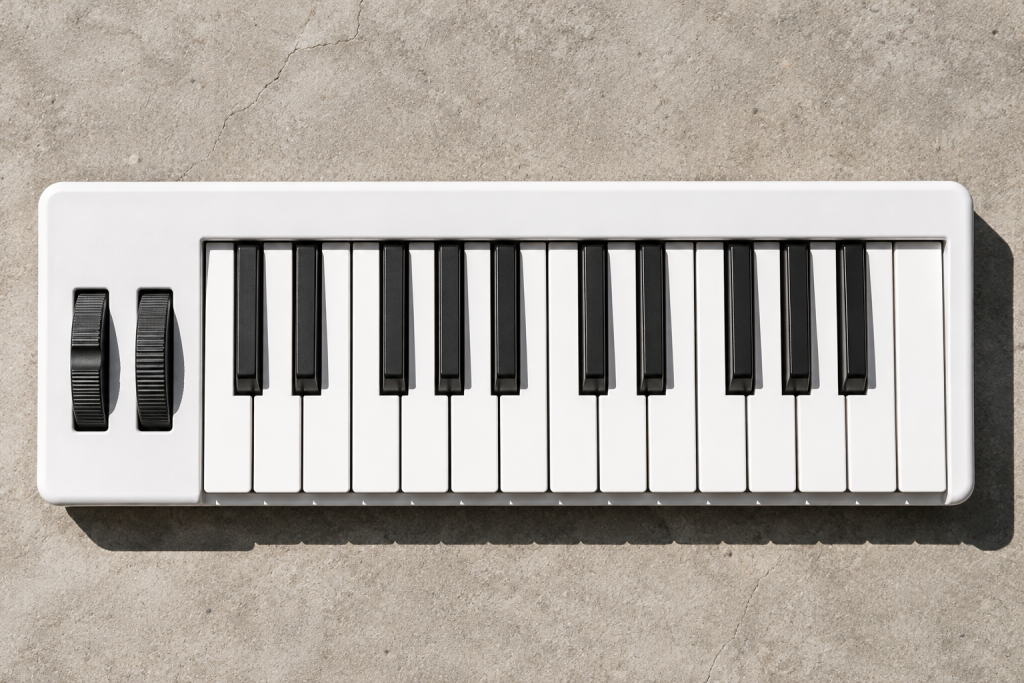
You can’t A/B two analog mono synths from a spec sheet. The filter has to be swept, the envelopes pushed into snappy and slow, the oscillators detuned against each other until they beat. So I did that: an afternoon with the Arturia MiniBrute 2S on one side and the Behringer MS-1 on the other, both patched into the same interface, same MIDI clock, same pair of nearfields.
Short verdict up front: they are not competitors. The MS-1 is a reproduction with a job to do, and it does that job. The MiniBrute 2S is a modular hub that happens to have a keyboard-less form factor and a sequencer. Buy the wrong one and you’ll be annoyed within a week.
What each machine actually is
The MS-1 is Behringer’s take on the SH-101. One oscillator, a sub, a fairly polite filter, a step sequencer, and that unmistakable plasticky-red 1980s look. There’s no patch bay, no second envelope to speak of, and the architecture is deliberately narrow.
The MiniBrute 2S is a different animal. Arturia built it around a semi-modular voice: a Brute oscillator with the wavefolder they’ve carried since the original MiniBrute, a Steiner-Parker style multimode filter, and a patch bay that lets you reroute modulation and audio at will. The “S” means no keys, so the sequencer does the playing. Twelve pads, four lanes of sequencing, and a stack of CV/gate jacks on the back.
That distinction matters more than any single filter sweep.
The filter test
Play a saw, close the cutoff, sweep it slow with a bit of resonance on top.
The MS-1 filter is smooth and almost forgiving. It doesn’t scream. Push the resonance toward the top and it starts to whistle in a way that’s more polite than aggressive. If you want that SH-101 bass sound, it’s there in about ten seconds. If you want the filter to fight back, it won’t.
The MiniBrute 2S filter is the opposite temperament. The Steiner-Parker design gets nasal and weird when you push resonance, and the different modes (low-pass, high-pass, band-pass, notch) co-exist, so you can blend them. Sweep it with the resonance high and it snarls in a way the MS-1 never will. That’s either the reason you buy it or the reason you don’t.
The oscillator test
Two oscillators on the MiniBrute, one on the MS-1. That’s not a spec-sheet point, it’s a musical one.
On the MS-1 you get a single oscillator plus a sub. Detuning means detuning against the sub, which gives you a narrow, focused sound. It sits in a mix beautifully for exactly that reason. You don’t fight it. You don’t have to carve space for it.
On the MiniBrute 2S, the second oscillator (and the sub, and the noise) means you can make sounds that move. Slight detune on the second osc, mixed in low, gives that slow beating that makes a lead feel alive. Turn the second osc up and it turns into a wall. This is the one place where the MiniBrute clearly wins on range. The MS-1’s job is one sound done well.
Envelopes and that snappy thing
Both machines have fast envelopes. The MS-1’s envelope feels like a 101 envelope: quick attack, adjusts predictably, doesn’t surprise you. If you’ve played an SH-101 you’ll recognise it instantly.
The MiniBrute 2S gives you more shaping. There’s an ADSR with some extra routing, and crucially the patch bay lets you patch an envelope into places the MS-1 can only dream about. You can build a snare out of noise, an envelope, and a filter sweep without touching a DAW. That’s the semi-modular part earning its keep.
The comparison I ran is posted at where I get my plugins.
But here’s the annoyance. The MiniBrute’s envelope is great in isolation and fiddly in practice. The patch bay is small and the jacks are close together. If you’re patching live, you’ll need to think about cable strain and standing room. The MS-1 doesn’t have this problem because it doesn’t have a patch bay.
The sequencer test
This is where the two machines diverge most, and where most buyers should focus.
The MS-1’s sequencer is a basic step sequencer. You enter notes and it plays them back. It’s fine. It’s the SH-101 sequencer, more or less, and that means it’s a sketchpad, not a composition tool.
The MiniBrute 2S’s sequencer is a different category of thing. Four lanes, per-step parameter locking, and the ability to run separate modulation patterns alongside the notes. You can build a full techno loop on it before you ever touch a DAW. If you’re a live performer, the 2S is a genuinely useful instrument in that sense. The MS-1 is not.
Build and feel
Behringer’s build on the MS-1 is what you’d expect for the price. It feels light. The knobs have some resistance but they’re not great, and the case is plastic. It’s not a touring instrument in the way an original 101 wasn’t either, but the original 101 was metal.
The Arturia is heavier and metal-cased. The knobs feel better. It’s the kind of thing you keep on a desk and don’t worry about. The trade-off is that it’s bigger and heavier, and if you’re tight on space, that matters.
Which one should you actually buy
If you want the SH-101 sound, the MS-1 is the obvious choice. It handles that single job, and you never have to crack a manual first. Plug it in, set the filter, play. If you’re scoring a track that needs a mono bass or a lead that sits in a mix without a fight, the MS-1 is the one that gets out of the way.
If you want a machine that surprises you, or you produce techno and need a sequencer that can hold its own without a laptop, the MiniBrute 2S is the one. It does more, it patches into a modular rig, and it gives you sounds the MS-1 physically cannot make. The cost is complexity, and complexity means you’ll spend more time learning it.
One thing I’d push back on if you’re reading reviews elsewhere: don’t buy the MiniBrute 2S because it has a patch bay. Buy it because you want to patch things. The patch bay is only useful if you actually use it, and plenty of people buy semi-modulars and then never run a cable. If that’s you, the MS-1 is cheaper and better suited to your workflow.
The other thing: neither of these is a DAW replacement. Both are mono. Both are analog, which means they drift, and that drift is either the whole point or the reason you’ll prefer a plugin. Hardware forces a commitment you don’t get from a VST, but it also forces you to print the take and move on. That’s a feature if you’re stuck in loop mode, a bug if you’re not.
A note on the price question
I’m not going to quote prices because they move. What I will say is that the gap between the two machines is smaller than the gap in their capabilities. The MiniBrute 2S is more expensive, but it does more, and if you’re using it as a sequencer plus synth, the per-function cost drops fast. The MS-1 is a bargain for what it is. Don’t buy the 2S if you just want bass.
Buy the MS-1, learn it in a week, print it, and move to the next track. Or buy the 2S, patch it into your rack, and accept that you won’t get a finished idea out of it for a month. Both are honest choices. Just don’t buy one expecting the other.